Hiển thị các bài đăng có nhãn Japan. Hiển thị tất cả bài đăng
Hiển thị các bài đăng có nhãn Japan. Hiển thị tất cả bài đăng
As Japan 's highest mountain ( 3.776m ) , Mount Fuji image snow all year long was to go into poetry , not painting at the soul of nature lovers spectacular but no less romantic in Japan

The mountain is located in the center of the island Honsu , stretching from Shizuoka to Yamanashi Prefecture southwest of Tokyo is more beautiful than watching from the green tea fields untouched or under the surface of the lake ripples surrounding foothills have not of that ?

According to legend , the first up to the summit of this mountain is a Buddhist monk that teen sir . As previously sacred mountains women should not be allowed to climb up the mountain . Today, it has become a hobby of adventure tourists around the world . It is estimated that each year about 300,000 followers conquered adventurous and explore the beauty of this place . We 're breathtaking beauty of the morning sunrise " Goraiko " on top of that legendary Mount Fuji ! Wow ! Magic too !

When viewed from the International Space Station ISS , Fuji still looks very attractive right ! But was located after the eruption in 1707 , geologists have put the mountain on the type of active volcanoes . Currently, they are concerned after an eruption from catastrophic magnitude 9 earthquake in 2011. Most recently , in September , Institute for Earth Science and Disaster Prevention , said that the pressure inside the volcano is gradually increased and the Fuji " awake " after 305 years " dormant " is difficult inevitable.

Image 7 Japanese Navy aircraft " squeezed " through the White Mountain summit of this world famous


The mountain is located in the center of the island Honsu , stretching from Shizuoka to Yamanashi Prefecture southwest of Tokyo is more beautiful than watching from the green tea fields untouched or under the surface of the lake ripples surrounding foothills have not of that ?
According to legend , the first up to the summit of this mountain is a Buddhist monk that teen sir . As previously sacred mountains women should not be allowed to climb up the mountain . Today, it has become a hobby of adventure tourists around the world . It is estimated that each year about 300,000 followers conquered adventurous and explore the beauty of this place . We 're breathtaking beauty of the morning sunrise " Goraiko " on top of that legendary Mount Fuji ! Wow ! Magic too !
When viewed from the International Space Station ISS , Fuji still looks very attractive right ! But was located after the eruption in 1707 , geologists have put the mountain on the type of active volcanoes . Currently, they are concerned after an eruption from catastrophic magnitude 9 earthquake in 2011. Most recently , in September , Institute for Earth Science and Disaster Prevention , said that the pressure inside the volcano is gradually increased and the Fuji " awake " after 305 years " dormant " is difficult inevitable.
Image 7 Japanese Navy aircraft " squeezed " through the White Mountain summit of this world famous
With the ability to disable the compass and global positioning devices and rumors have goblins , demons harassing , Aokigahara forest at the foot of Mount Fuji is seen as the place " of the soul loitering " each lost or suicide here .
Kawaguchi , Yamanaka , Sai , Shoji and Motosuu - 5 large fresh water lake surrounded Fuji brings beauty " flavored water color sky " , perfectly harmonious symbol of pride for the originating .
This is the field next season Shinkansen Bullet express train station near the mountain
Wow ! Night view of the Kanagawa , near Fuji how beautiful !
White and pure mountain air and pink cherry blossoms seen from a temple in Tokyo
From early July to late August is the season of tourists climbing all over the place . Journey climb takes about 3 to 7 hours , over 10 base stations
It is estimated that each year there are about 4 people died and 10 were injured due to reduced body temperature and the accident occurred in the process of conquering the peak . However, this is not an obstacle to many " followers " love high adventure and conquest for Mount Fuji is one of the most fascinating journey of the world .
Oh ! Look at this perfect beauty of lush purple foothills where the constant waves calm lake surface reflects the majestic mountains , a romantic flutter to mind !
Mount Fuji has a crater 850m deep and 220m wide . Entire trees only grow from 2,400 to 2.800m altitude or lower altitude remaining barren slopes with lava erupted from long
Fuji is one of the " Three Holy mountain " in Japanese . This is a picture of the flower festival held in Shibazakura
This is the " fence " Shinjuku skyscraper " walked " with Fuji seen from Bunkyo City Centre .
A majestic Fuji seen from Asagiri high plateau on the border of two counties 1.964m Yamanashi and Shizuoka .
And here is the picture of Mount Fuji seen from Yokohama
Motosu lake shimmering reflection beautiful snow-covered mountains . Motosu deep lake 9th Japan ( 140m ) , along with Saiko and Shojiko , 3 lakes were formed from the lava of Fuji
Thousand flowers blooming and blue petal majestic place untouched entitled " Penglai first sight "
Fuji shimmering blur seen from the Lake Ashi in green , flat
" The Double " perfect between the highest peaks and the originating Shojiko lake dawn . Shojiko is the smallest lake in " five lakes " surrounded Fuji
Enjoy the majestic beauty of the originating Mount Fuji
Features of the most sophisticated and fussy the Golden Temple is a very impressive position among the green canopy of tree leaves and pure light reflective stillness of the lake .


Kinkakuji Temple - Golden Temple also known as Wat a ROKUONJI located in the northwest of Kyoto . Populations temple was built in 1393 and used as a getaway for Shogun Ashikaga Yoshimitsu ( 1358-1408 ) .
Golden Temple is famous to be included in the textbooks taught in schools throughout Japan and is recognized by UNESCO as world cultural heritage in 1950 however a minor increase whole temple was burned along with 6 important cultural heritage in the temple . In 1955 the temple was rebuilt but since then the temple was not sure anymore Korea considered . The current appearance of the Golden Temple in 1955 and has been inlaid in gold once the habit in 1987 .
Features of the most sophisticated and fussy the Golden Temple is a very impressive position among the green canopy of tree leaves and pure light reflective stillness of the lake . The picture should be drawn from the idea of the existence between earth and paradise . The harmony of the temple with water balloons really do damage to a Kinkaku - The most popular scenario of Kyoto .
A point represents prestige and power of the generals 3rd floor ceiling covered with thin gold leaf . Today, the entire temple except the ground floor are covered with pure gold leaf , making the temple extremely large value . Golden Temple is also a symbol of spiritual values , was once a Shariden ( Temple relics ) - Buddhist relics .
Enjoy the beautiful Golden Temple during 4 seasons :
Spring : Spring Japanese with temperatures about 10 degrees C , an ideal opportunity for those who like to enjoy the scenery . Moreover spring is the season of festivals . Cherry blossoms scattered on the mountains as well as on the entrance to the temple . What could be more beautiful .
Summer : When the sun 's blazing summer starts , the projector is also around the time of Kinkakuji garden insect voices cry torn coriander called you . The bamboo forest murmurs of the wind in the quiet summer night will give you a better sense of retreat .
Fall : If one has to Kinkakuji in autumn once would never forget the famous red maple leaf . Each reef style color red as sunset made Kinkakuji become bright . Perhaps looking at this scene you can think of it just like in the fairy .
Winter: If someone is afraid of cold winter in the temple , do not worry . Because winter is the best season in years Kinkakuji . Each heavy white flakes falling on the roof of the temple makes my heart flutter more easily at any time. Light snow is up on the warm yellow of the curved pagoda . It is sunlight dispel cold cold winter .
Kinkakuji -Marvels Golden Temple in Japan
Away from the rush , hurry , scurrying in Tokyo , Kyoto rhythm hidden behind hills covered with trees, flowers, hidden under the houses built in the ancient style , much like the slow , gentle , fresh , have similarities with poetic beauty as the Perfume River Hue of Vietnam .

Kyoto is one of seven major cities in Japan , with a population of about 1.5 million people . The city was formerly the capital of Japan , this is the provincial capital of Kyoto Prefecture , and is a major part of the Kansai metropolitan area . This is the place to preserve the value of traditional Japanese culture .
It is still known today Kyoto is the embodiment of ancient Japanese legend . More than half of temples and shrines of ancient palatial castle in Japan are concentrated in Kyoto , including 14 temples in the World Heritage list of UNESCO , and more than 1,700 treasures and cultural assets national importance have been approved by the Japanese government .
One of the most famous works in Kyoto ( which is also probably the most famous Japanese ) Kiyomizu - temple is beautiful temple has been included in the list of nominees for the 7 natural wonders of the world .
The name of this temple is that pure water ( Kiyo - bar , Mizu - hydro ) . The pagoda was built in 778 , is the oldest building in the ancient architecture in Kyoto , located on the hills Otawa .
Temple 3 famous clear water flowing out from the cliff , symbolizing the three greatest desire of man is love , health and money . Who here are also lined pure rice bran drip from the cliffs to drain a sip luck .
The temple has been the main space is completely wooden building with large pillars 139 . By the fall, Kiyomizu don the robes woven with thousands of red maple leaves as Penglai first sight .
In addition, there Kyoto Kinkaku - ji ( Kim The self ) ie Golden Temple . Who has not come to Kyoto which is considered not to Kyoto . This temple was built in 1397 , initially only the roof of the second floor and the third floor is Kinkaku - ji Golden Pavilion .
At the end of the 19th century , the temple has undergone a major restoration , and then the entire surface and the outer surface of this massive block architecture ( including 3 floors ) were covered in gold , bring beauty where there is no Kinkaku - ji is given , especially in the autumn sunny day , one can admire the sparkle and precious , turn this place into one of the scenic most attractive Master Tang .
Through artifacts , scientists have confirmed the human settlements in the Kyoto area from 10,000 BC . However, evidence of man's activities before the 6th century no more . In the 8th century to avoid the influence of the Buddhist clergy interjected the country , chose Emperor moved the capital from Nara to Kyoto area today to create distance from the center of contemporary Buddhism .
New city , now called Heianky , became the capital of Japan in 794 . After that , the city was renamed Kyoto . Kyoto is to keep the status of Japan's capital until the 19th century when the court moved to Edo ( Tokyo ) in 1868 at Meiji dynasty . So far, many Japanese still believe that Kyoto was the capital of Japan official .
The final phase of World War II , the United States has considered the possibility atomic bombing of Kyoto but ultimately chose Hiroshima and Nagasaki because it destroys not " the beauty of the city " is.
Kyoto is the city 's only major Japanese buildings still time before the Second World War as traditional Machiya town hall . Kyoto is the place famously hosted an international conference to respond to global climate change and the Kyoto Protocol in 1997 with the goal to cut emissions causing the greenhouse effect .
Ancient Kyoto attractive by definition along with the ancient temple architecture characterized Japan , the coffee bar and modern seems to bring a new breath into the definition phase this quiet place .

Despite the industrialization and modernization of the ancient capital Kyoto but still preserve and promote traditional cultural values brought from insoluble aggregates of Japan .
As honored guests , we were colleagues Kyodo News receptions introducing the culinary culture of the customary traditional Japanese Maiko , geiko singing, dancing , piano , Ochaya entertainers in bars in the area hanamachi city called Kyoto .
Kyoto has 5 zones such hanamachi , which must include the most famous Gion district about 100 Ochaya regular activities . The Maiko , pouring new wine geiko knees , enthusiastically serving our festive meal at a restaurant two wooden floors have introduced more than a hundred years ago .


Kyoto is one of seven major cities in Japan , with a population of about 1.5 million people . The city was formerly the capital of Japan , this is the provincial capital of Kyoto Prefecture , and is a major part of the Kansai metropolitan area . This is the place to preserve the value of traditional Japanese culture .
It is still known today Kyoto is the embodiment of ancient Japanese legend . More than half of temples and shrines of ancient palatial castle in Japan are concentrated in Kyoto , including 14 temples in the World Heritage list of UNESCO , and more than 1,700 treasures and cultural assets national importance have been approved by the Japanese government .
One of the most famous works in Kyoto ( which is also probably the most famous Japanese ) Kiyomizu - temple is beautiful temple has been included in the list of nominees for the 7 natural wonders of the world .
The name of this temple is that pure water ( Kiyo - bar , Mizu - hydro ) . The pagoda was built in 778 , is the oldest building in the ancient architecture in Kyoto , located on the hills Otawa .
Temple 3 famous clear water flowing out from the cliff , symbolizing the three greatest desire of man is love , health and money . Who here are also lined pure rice bran drip from the cliffs to drain a sip luck .
The temple has been the main space is completely wooden building with large pillars 139 . By the fall, Kiyomizu don the robes woven with thousands of red maple leaves as Penglai first sight .
In addition, there Kyoto Kinkaku - ji ( Kim The self ) ie Golden Temple . Who has not come to Kyoto which is considered not to Kyoto . This temple was built in 1397 , initially only the roof of the second floor and the third floor is Kinkaku - ji Golden Pavilion .
At the end of the 19th century , the temple has undergone a major restoration , and then the entire surface and the outer surface of this massive block architecture ( including 3 floors ) were covered in gold , bring beauty where there is no Kinkaku - ji is given , especially in the autumn sunny day , one can admire the sparkle and precious , turn this place into one of the scenic most attractive Master Tang .
Through artifacts , scientists have confirmed the human settlements in the Kyoto area from 10,000 BC . However, evidence of man's activities before the 6th century no more . In the 8th century to avoid the influence of the Buddhist clergy interjected the country , chose Emperor moved the capital from Nara to Kyoto area today to create distance from the center of contemporary Buddhism .
New city , now called Heianky , became the capital of Japan in 794 . After that , the city was renamed Kyoto . Kyoto is to keep the status of Japan's capital until the 19th century when the court moved to Edo ( Tokyo ) in 1868 at Meiji dynasty . So far, many Japanese still believe that Kyoto was the capital of Japan official .
The final phase of World War II , the United States has considered the possibility atomic bombing of Kyoto but ultimately chose Hiroshima and Nagasaki because it destroys not " the beauty of the city " is.
Kyoto is the city 's only major Japanese buildings still time before the Second World War as traditional Machiya town hall . Kyoto is the place famously hosted an international conference to respond to global climate change and the Kyoto Protocol in 1997 with the goal to cut emissions causing the greenhouse effect .
Ancient Kyoto attractive by definition along with the ancient temple architecture characterized Japan , the coffee bar and modern seems to bring a new breath into the definition phase this quiet place .
Despite the industrialization and modernization of the ancient capital Kyoto but still preserve and promote traditional cultural values brought from insoluble aggregates of Japan .
As honored guests , we were colleagues Kyodo News receptions introducing the culinary culture of the customary traditional Japanese Maiko , geiko singing, dancing , piano , Ochaya entertainers in bars in the area hanamachi city called Kyoto .
Kyoto has 5 zones such hanamachi , which must include the most famous Gion district about 100 Ochaya regular activities . The Maiko , pouring new wine geiko knees , enthusiastically serving our festive meal at a restaurant two wooden floors have introduced more than a hundred years ago .
The Maiko , geiko kimono wearing splendid colors , bold makeup style traditional , speak fluent English , invited pours knees , dedicated customer service throughout the meal every few hours.
There are differences in dress , hairstyle Maiko and geiko , but the most obvious is the Kimono Maiko usually wear colorful , long arms , and the hairstyle depends on each stage in the career of Maiko , is bent of her real hair and brooch decorated with flowers , brightly than geiko .
After determination requires hard work , the 20 -year-old Maiko will have to decide your way forward . Continue become geiko , then she has not been allowed to marry and to continue work on guitar , sings and dances its longtime mentor novice class .
Before officially become geiko few days , Maiko will have holiday hairstyle changes . Become a geiko , the bun in her hair would not really have the team that his wig was called katsura tufts available .
To cut the long hair and had to stick with her for many years as well as regret for not less that the Maiko in early adult geiko . Costumes and makeup , the geiko is somewhat deeper , not brilliant as Maiko .
Before closing reception a hit senior Maiko shamisen , a characteristic of Kyoto as elastic Vietnam's Tay people to Maiko , young geiko performing five dances of Japan at the kitchen table attachment leave you with a message promised to meet again .
Want to be a party to such registration at least 20 days ; extremely high prices . Although expensive prices but in 2009 , Kyoto still attracts more than 5 million tourists , of which more than two thirds are foreign tourists . It is also probably the charisma , the secret of success of the ancient capital of Kyoto .
Red leaf season in the ancient capital of Kyoto - Attractive Destination
Shinjuku is one of the 23 special wards simultaneously be regarded as the administrative center cuaTokyo because government buildings in the capital Tokyo play here . Shinjuku is also a commercial area busiest in Tokyo , especially the area around Shinjuku Station , which was dubbed the " black hole consumption " .
Edo , today's Shinjuku area is adjacent to Edo , so it has become an area of culture development . Many temples have been built at Yotsuya Shinjuku . Shinjuku began to develop in its current form after the Great Kanto earthquake in 1923 . West Shinjuku , where the quake- devastated after being rebuilt with skyscrapers . Tokyo bombing campaign by the U.S. Air Force in the Second World War had destroyed about 90 % of the structures in and around Shinjuku Station . Modern Shinjuku officially established on March 15, 1947 on the basis of three district merger Yotsuya , and Yodobashi Ushigome together .
 |
| Shinjuku City |
Daytime pretty quiet here , peaceful , with small restaurants , not too lavish , luxurious and affordable prices , delicious dishes . The restaurant has a glass case , inside the plastic dishes identical foods . Just seeing brilliant colors , lively Our customers wanted to step foot on the land of food there.
But at night , you do not even realize Shinjuku because it would reverse the daytime . The restaurants , fashionable , affordable racing entertainment centers bright flashing lights , makes sense bustling , busy for a modern amusement park . It's time for bars, nightclubs , massage parlors , love hotels ( love hotel ) is open and welcoming visitors . The girl with billboards or flyers on hand , always smiling cheerful customer to offer their services . The bar , the dance floor is the place to spend money here " catch up," the boy 's warm , she moves or tourists wishing to entertain strangers . But as the night air but bring back " fiery " for the entire city.
 |
| Boisterous night in Shinjuku |
Shinjuku Station :
With 2 million visitors each day . Shinjuku Station is the busiest ranked in the world . 6 tram station operating company , more than a dozen routes including the car on the ground and subways , is the ideal place for you to make these outings , excursions . Train broad that , if followed , the outer loop takes an hour to make a new starting point .
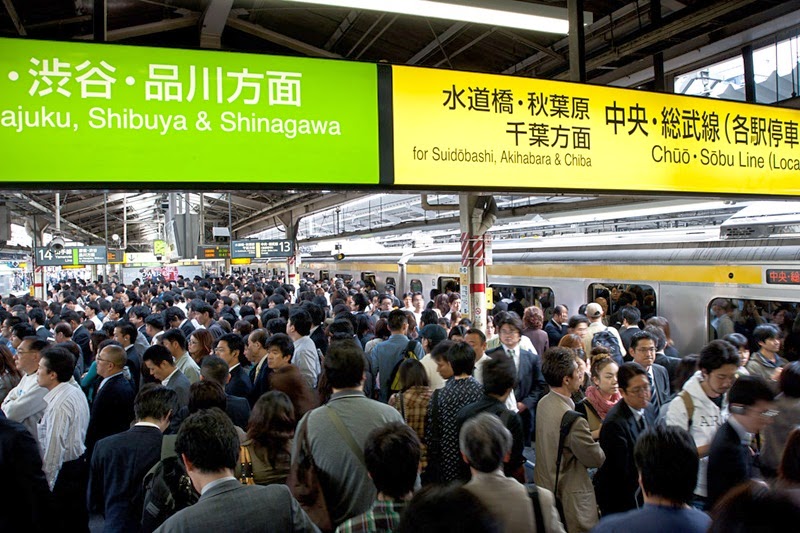 |
| Shinjuku station at rush hour. |
The skyscraper :
Most of these buildings have eaten at the top restaurants , allowing diners to observe and admire the beauty of the city . We usually have over 200 meters high , over 50 floors , with modern design and luxury , beauty and respect for Shinjuku brilliant .
 |
| The skyscrapers in Shinjuku. |
Tokyo Opera City :
Located in the southwest of Shinjuku . With a structure consisting of national theaters and museums , there are three performance space and exhibition , showcasing the high-tech products of the largest telcos Japan ( ICC )
 |
| Inside the Tokyo Opera theater. |
Government office buildings - Tokyo Metropolitan City Government :
Is the 4th tallest building in Japan , are distinguished from other buildings by 2 tall towers are very high . ( 296 meters ) . Standing on the 45th floor of this building , radioactive eye , you can easily enjoy views of Mount Fuji and the country's bustling Shinjuku .
Government office buildings open to visitors on tours on all days of the week .
 |
| Government office buildings. |
Takashimiya Times Square
 |
| Square Takashimiya. |
The square is a combination including luxury restaurants , cafes excellent , spacious playground and pavilion modern fashion . There is also Tokyo Imax Theater 3D cinema widescreen Japan's first , is place your stop after 1 day to go shopping around the area . In the evening , the tourists are concentrated in the square and enjoy the perfect service of Shinjuku . Prices here but expensive and have many additional surcharge , but quality of service of staff can also make you completely satisfied . So it just is a " sucking " money from residents , just as " black holes consumer " of visitors.
 |
| The beauty national park in Shinjuku. |
Shinjuku - Black Hole Consumer
Tokyo Travel guide - Tokyo in 3 days trip
Where to go in Tokyo?
Japan’s most famous district is not famous for nothing! Tokyo is an exhilarating experience! With 33.5 million people just in Tokyo alone, the area is bustling with life and practically pulsating in energy! In Tokyo you can find both energy and solace. Shinto shrines adorn towering skyscrapers and give a sense of zen in the middle of all the noise. The traditional and modern coexist in perfect harmony.
So you have 3 days in Tokyo. How are you going to fit everything you want to do in the land of samurai punk rockers?

Day 1: Tokyo at First Glance
If you take the Tokyo Morning Tour, you will find yourself in the tallest self-supporting tower in the world, The Tokyo Tower. It stands 1092.52 feet tipping the Eiffel Tower by 43 feet. Up in Tokyo Tower, you can see everything Tokyo has to offer at first glance. You can do your photo ops at the Imperial Palace Plaza through Ueno and Akihabara to Asakusa Kannon Temple. You can do more shopping at Nakamise and Ginza and find an impressive pearl cultivation showroom at Tasaki Pearl Gallery.
You can do all that in the morning because after lunch, you could check out the famous Kabuki at Tokyo Kabuki-za. Kabuki is a traditional form of Japanese Theater that showcases an amazing array of costumes, makeup, song and dance. An Engligh language closed-circuit audio service is available for your convenience.

Sumo, Japan’s oldest sport dates back 1500 years. If you’re one who prefers something a little more hands-on and primeval you might want to check this out. These heavy weight guys eat around 20,000 calories every day, that’s about 10 times the adult daily requirement!
When the sun sets, you can go on the Tokyo Night Tour and Japanese Dinner. Sanju Sangendo is the right place to be to get the real deal on Japanese food. The night tour goes across Rainbow Bridge to Aqua City and then through Akasaka and Ginza. To cap the night with a breathtaking view and experience, the night tour ends in Roppongi Hills giving you a view of Tokyo at night.

Day 2: Bullet Train and Mt. Fuji
When one thinks of Japan, Mt. Fuji is one of the most frequent things that come to mind. The Mt. Fuji and Hakone Day Tour takes you from Tokyo via countryside and then up to Mt. Fuji 5th Station. Mt. Fuji stands 12,388 feet and when you reach there, you’d soon find out why it is one of the most iconic images that Japan has of its country. After lunch you can take a cruise on Lake Ashi, and then take a cable car ride in Mt. Komagatake, then to Odawara and then finally board the Shinkansen (Bullet Train) for your trip back to Tokyo.

Day 3: On to Nikko and Kamakura’s Buddha
The Toshogu Shrine and Mausoleum can be found at the entrance of the Nikko National Park. Japanese religious beliefs can be rooted here as both Shinto and Buddhist worship was practiced in the vast mountains and lakes, waterfalls and hot springs. The tour takes you to Irohazaka mountain road. Located at the foot of Mt. Nantai is Lake Chuzenji.
You can also spend the day doing the Kamakura Walking Tour. The Kotokuin Temple houses the Great Buddha towering at 37.4 feet high. The walking tour shows you the Hase Kannon Temple, a great view of the town and the Pacific Ocean. Feeling a little rustic? You can take a rickshaw ride to Tsurugaoka Hachimangu Shrine where you can likewise head on over to Komachi shopping street and choose from the arsenal of arts and crafts.

Where to go in Tokyo?
Japan’s most famous district is not famous for nothing! Tokyo is an exhilarating experience! With 33.5 million people just in Tokyo alone, the area is bustling with life and practically pulsating in energy! In Tokyo you can find both energy and solace. Shinto shrines adorn towering skyscrapers and give a sense of zen in the middle of all the noise. The traditional and modern coexist in perfect harmony.
So you have 3 days in Tokyo. How are you going to fit everything you want to do in the land of samurai punk rockers?
Day 1: Tokyo at First Glance
If you take the Tokyo Morning Tour, you will find yourself in the tallest self-supporting tower in the world, The Tokyo Tower. It stands 1092.52 feet tipping the Eiffel Tower by 43 feet. Up in Tokyo Tower, you can see everything Tokyo has to offer at first glance. You can do your photo ops at the Imperial Palace Plaza through Ueno and Akihabara to Asakusa Kannon Temple. You can do more shopping at Nakamise and Ginza and find an impressive pearl cultivation showroom at Tasaki Pearl Gallery.
You can do all that in the morning because after lunch, you could check out the famous Kabuki at Tokyo Kabuki-za. Kabuki is a traditional form of Japanese Theater that showcases an amazing array of costumes, makeup, song and dance. An Engligh language closed-circuit audio service is available for your convenience.
Sumo, Japan’s oldest sport dates back 1500 years. If you’re one who prefers something a little more hands-on and primeval you might want to check this out. These heavy weight guys eat around 20,000 calories every day, that’s about 10 times the adult daily requirement!
When the sun sets, you can go on the Tokyo Night Tour and Japanese Dinner. Sanju Sangendo is the right place to be to get the real deal on Japanese food. The night tour goes across Rainbow Bridge to Aqua City and then through Akasaka and Ginza. To cap the night with a breathtaking view and experience, the night tour ends in Roppongi Hills giving you a view of Tokyo at night.

Day 2: Bullet Train and Mt. Fuji
When one thinks of Japan, Mt. Fuji is one of the most frequent things that come to mind. The Mt. Fuji and Hakone Day Tour takes you from Tokyo via countryside and then up to Mt. Fuji 5th Station. Mt. Fuji stands 12,388 feet and when you reach there, you’d soon find out why it is one of the most iconic images that Japan has of its country. After lunch you can take a cruise on Lake Ashi, and then take a cable car ride in Mt. Komagatake, then to Odawara and then finally board the Shinkansen (Bullet Train) for your trip back to Tokyo.
Day 3: On to Nikko and Kamakura’s Buddha
The Toshogu Shrine and Mausoleum can be found at the entrance of the Nikko National Park. Japanese religious beliefs can be rooted here as both Shinto and Buddhist worship was practiced in the vast mountains and lakes, waterfalls and hot springs. The tour takes you to Irohazaka mountain road. Located at the foot of Mt. Nantai is Lake Chuzenji.
You can also spend the day doing the Kamakura Walking Tour. The Kotokuin Temple houses the Great Buddha towering at 37.4 feet high. The walking tour shows you the Hase Kannon Temple, a great view of the town and the Pacific Ocean. Feeling a little rustic? You can take a rickshaw ride to Tsurugaoka Hachimangu Shrine where you can likewise head on over to Komachi shopping street and choose from the arsenal of arts and crafts.
Tokyo Travel guide - Tokyo in 3 days trip
Mount Fuji. Japan’s highest mountain (3776 meters, 12,377’) is unquestionably the country’s most iconic natural landmark. Photographed in all seasons from all angles, its near perfect cone is climbed by one quarter million people yearly, usually during the months of July and August. Its high visibility and traffic is partially owed to its proximity to the Kanto, or the plain surrounding Tokyo. However the best time to view the mountain is in the winter months when visibility is best. Considered one of the three holy mountains in Japan, along with Tateyama and Hakusan, there is understandably a collection of shrines on the crater rim. Since many people climb the mountain hiking trails and facilities are well established and there is a considerable amount of development on the mountain. The meteorological station marks the high point of the mountain and the country. Popular hiking routes to the summit are Gotemba, Fujinomiya, and Kawaguchiko. All of the trails have ten stations each, which are situated strategically to offer refreshments, lodging, and facilities for the hikers and tourists alike. Most hikers start from the 5th station/s, which are located between 6,000’ – 7,000’ and have access by paved roads. However, Mount Fuji lacks train access. If you are interested in climbing and don’t have a POV the best way to get there is by catching one of the many Fuji-bound buses departing from Shinjuku Station in Tokyo during the months of July and August. Fu
ji, a strato-, or composite volcano, last erupted in 1708 and is considered dormant.
Ginza, Tokyo. A UNESCO World Heritage Site it is not, but instead an unofficial shrine to Japan’s industry, technology, and material culture, if there is one. Ginza epitomizes Tokyo, if not Japan. It’s ground zero for neon, shopping, and as close to what Tokyo calls center, or downtown, for such a huge city. Within walking distance are the National Diet, the center of Japan’s government, and the Imperial Palace, a vast complex of buildings, which houses Japan’s Head of State, the Emperor of Japan and his administrative apparatus. Ginza is best experienced at night so you can view the electronic fireworks. There are so many interesting places in Tokyo and this is a logical place to orient yourself if you visit Japan’s largest city and capital.
Himeji Castle. Japan’s most famous castle and one of twelve that is in its original condition. Known as the “White Heron Castle”, it is one of the three most famous in the country, and the most visited. Its fame, not to mention its beauty, is perhaps why it was used as one of the locations for shooting the 007 film, You Only Live Twice (1967) starring Sean Connery. Located in Himeji, Hyogo prefecture, not far from Osaka, the castle is surrounded by pine and cheery trees, which make it especially scenic in the spring. A UNESCO World Heritage Site, its original construction was between 1333-1346 with other expansions occurring in 1601-1608, a well-known period for castle building in Japan. Not without coincidence it was during this time period when warlords fought for control of the country.
Bomb Dome, Hiroshima. The Bomb Dome has the dubious distinction of being almost directly under “Little Boy” when it detonated over Hiroshima on August 6, 1945. The remains of the Prefectural Industrial Promotion Hall have, ever since, come to be known as the Bomb Dome, or Genbaku Domu. Designed in 1916 by a Czech architect named Jan Letzel, the structure survived reasonably intact even though it was a mere 150 meters from the hypocenter. Today, it’s the centerpiece of the Hiroshima Peace Memorial Park and consequently attracts thousands of people to the otherwise industrial city. It was made a UNESCO World Heritage Site in 1996 although both the United States and China strongly objected. The museum has some very graphic photos of the aftereffects, which killed 70,000. Much debate continues today over the necessity of the bomb. The FDR and Truman administrations expended an incredible amount of time, money, and manpower into the development of the A-bomb, and some historians believe this weighed heavily on the decision to use it on Hiroshima and Nagasaki. The Battle of Okinawa gave further pause to the U.S. military and the planned land invasion of Japan because of the tremendous loss of military and civilians estimated at 120,000.
Kamakura. The outdoor Daibustu is, alongside Miyajima’s “floating torii”, the best known monument in Japan. Kamakura is close to Tokyo, even closer to Yokohama, so day trips from the Kanto are easy. Known as the Great Buddha it was once housed in a building that was destroyed by a typhoon in the 15th century. For the curious, the statue is 13.35 meters (44 feet) high and weighs 93 tons. The first mention of the bronze statue dates to 1252. Now hoards of tourists come to get their photos taken in front of the Daibutsu and the many edible (and rotten) offerings left at its foot. The city has a long history and perhaps that’s why the Daibutsu stands. Although the Daibutsu gives Kamakura its deserved recognition the city’s historical record is long and rich. It is no accident that a period in Japanese history is named the Kamakura period (1185-1333), which marked the beginning of the shogunate established in the city. The city is also famous for Nichiren Buddhism, found by the Japanese monk Nichiren (1222-1282) and sometimes associated with radicalism. It is also recognized as a UNESCO World Heritage Site.
Kinkaku-ji, Kyoto. It is best known as the Golden Pavilion and it said to be Japan’s most visited site and its beauty, accented by surrounding pine trees and ponds, is remarkable. The Temple of the Golden Pavilion’s history dates to 1397 and it is affiliated with Zen Buddhism. The one you look at today dates to 1955 thanks to a radical Buddhist monk who burned it down in 1950. Despite its relatively recent date, it still draws crowds of the camera-ready Japanese who become frenzied with picture taking. Recognized as a UNESCO World Heritage Site, it is however only one of many historic and cultural sites in Kyoto, Japan’s cultural capital. A trip to Kyoto would not be complete without visiting Heian shrine, Kiyomizu-dera, Nijo castle, To-ji, and of course the less spectacular Ginkaku-ji, or the Silver Temple Pavilion. There’s much more too as the city has 17 places designated UNESCO World Heritage Sites. Most date from between the 10th and 19th centuries. The incidence of many prewar buildings in Kyoto is because the city was largely sparred as a bombing target in WWII.
Matsumoto Castle. Construction started in 1504 and the castle eventually was nicknamed the “Crow Castle” because of its resemblance of that bird with outstretched wings. It remains one of twelve castles in Japan that have survived reasonably intact of any major structural damage other than routine repair since the Meiji Restoration began in 1868. Its fame is further enhanced by the well deserved designation as one of the three finest in Japan along with Himeji (see above), and Kumamoto Castle. What makes it unique is the water-filled moat, something the other two do not have. Following the Meiji Restoration the Castle was slated to be demolished but locals, led by a school principal, managed to save it from destruction by land developers. Still the outer castle was demolished and what remains is the beautiful keep. Some of the gates have been rebuilt as have many other castles across Japan that once stood during the long period of shogunate, or warlord, rule. The castle is considered a National Treasure of Japan and it does not belie such a designation. Located away from the coastal area, Matsumoto is as far inland as you can get in Japan and it remains a gateway to the Kita Alps. The Kaichi gakko (school) in Matsumoto is also worth seeing and is located close to the castle. Modeled after western school buildings with a central cupola adjoined by two wings, it looks out of place in Japan, yet it was built in the 1870s.
Miyajima. The “floating torii” is arguably Japan’s most iconic man-made landmark along with Kamakura’s Daibutsu. Often featured on JTB http://www.jtbusa.com/ posters, this monument symbolizes Japan, but is actually a small part of a complex of shrines on Miyajima, which translates to the “Island of Shrines” for good reason. Located close to Hiroshima in the Inland Sea, the island is more formally known as Itsukushima (StrictIsland) and, like Nara, has a population of resident deer that are ready for handouts, too skittish to pet, and leave droppings everywhere. Of course many come to photograph the torii (shrine gate) built in 1874, although one has stood in the water for the last seven centuries. At low-tide it actually sits on a mud flat. Still, the island has played host to other shrines as early as the 6th century since the island is a holy Shinto site. Take your time and allow a day. Adjacent to the torii is the five story pagoda built in 1407 and Senjokaku Hall (c. 1587). Although there is a ropeway to the top of Mount Misen (535 meters, 1755’) hiking to the top of this mountain along one of the paths is suggested because of the virgin timber stands. The torii and shrine have been designated a UNESCO World Heritage Site.
Nikko. Nikko is a long day trip from Tokyo, but possible if you take the shinkansen, or high-speed rail, which stops in Utsunomiya 35 km to the east. Set in the mountains, the town has a number of famous shrines and temples that make it well worth the visit. Against a backdrop of mountains, beautiful forests, and rocky, wooded, ravines with fast flowing streams the temples and shrines are perfectly set in their natural background. The town essentially developed around the temples, the first said to have started in 766. Among the most famous are the Toshogu Shrine, founded in 1617, with its ornamental gate and Three Wise Monkeys. The Shrine is set among giant cryptomeria trees, a relative of the cedar. The Futarasan Shrine, founded in 767, is at the base of Nantai-san, a sacred mountain popular with hikers. Nearby is the beautiful Sacred Bridge which spans a brook. Finally there is the Rinno-ji, a complex of Buddhist temples, with its beautiful ornamental wood work, established in 766. All three are UNESCO World Heritage Sites. Besides the shrines and temples there is the nature of Nikko: Lake Chuzenji and Kegon Falls, one of the three highest in Japan, which drains the aforementioned lake. The mountains are breathtaking and rise abruptly from the town. Watch for the monkeys on the winding road that leads up to the lake. The Japanese Macaque can often be seen foraging along the road.
Todai-ji Hall, Nara. Nara is not to be missed by any visitor to Japan. It’s Japan’s oldest capital and traditionally ranks as its first city. Founded in the 8th century, Nara’s best known monument is Todai-ji Hall, the world’s largest wooden building. It’s hard to get a sense of scale until you stand beneath it. Inside are the gigantic Daibutsu (Buddha) and other humungous statues. A number of buildings have stood on the site and the latest dates from 1709; only two-thirds the size of the building that preceded it, which was destroyed by fire. Todai-ji Hall incidentally is also the center of Kegon Buddhism in Japan. There are other interesting sites in Nara as well and some archaeological foundations of the ancient city. Also of interest are the skittish deer that inhabit the city and wander the streets looking for handouts.
ji, a strato-, or composite volcano, last erupted in 1708 and is considered dormant.
Ginza, Tokyo. A UNESCO World Heritage Site it is not, but instead an unofficial shrine to Japan’s industry, technology, and material culture, if there is one. Ginza epitomizes Tokyo, if not Japan. It’s ground zero for neon, shopping, and as close to what Tokyo calls center, or downtown, for such a huge city. Within walking distance are the National Diet, the center of Japan’s government, and the Imperial Palace, a vast complex of buildings, which houses Japan’s Head of State, the Emperor of Japan and his administrative apparatus. Ginza is best experienced at night so you can view the electronic fireworks. There are so many interesting places in Tokyo and this is a logical place to orient yourself if you visit Japan’s largest city and capital.
Himeji Castle. Japan’s most famous castle and one of twelve that is in its original condition. Known as the “White Heron Castle”, it is one of the three most famous in the country, and the most visited. Its fame, not to mention its beauty, is perhaps why it was used as one of the locations for shooting the 007 film, You Only Live Twice (1967) starring Sean Connery. Located in Himeji, Hyogo prefecture, not far from Osaka, the castle is surrounded by pine and cheery trees, which make it especially scenic in the spring. A UNESCO World Heritage Site, its original construction was between 1333-1346 with other expansions occurring in 1601-1608, a well-known period for castle building in Japan. Not without coincidence it was during this time period when warlords fought for control of the country.
Bomb Dome, Hiroshima. The Bomb Dome has the dubious distinction of being almost directly under “Little Boy” when it detonated over Hiroshima on August 6, 1945. The remains of the Prefectural Industrial Promotion Hall have, ever since, come to be known as the Bomb Dome, or Genbaku Domu. Designed in 1916 by a Czech architect named Jan Letzel, the structure survived reasonably intact even though it was a mere 150 meters from the hypocenter. Today, it’s the centerpiece of the Hiroshima Peace Memorial Park and consequently attracts thousands of people to the otherwise industrial city. It was made a UNESCO World Heritage Site in 1996 although both the United States and China strongly objected. The museum has some very graphic photos of the aftereffects, which killed 70,000. Much debate continues today over the necessity of the bomb. The FDR and Truman administrations expended an incredible amount of time, money, and manpower into the development of the A-bomb, and some historians believe this weighed heavily on the decision to use it on Hiroshima and Nagasaki. The Battle of Okinawa gave further pause to the U.S. military and the planned land invasion of Japan because of the tremendous loss of military and civilians estimated at 120,000.
Kamakura. The outdoor Daibustu is, alongside Miyajima’s “floating torii”, the best known monument in Japan. Kamakura is close to Tokyo, even closer to Yokohama, so day trips from the Kanto are easy. Known as the Great Buddha it was once housed in a building that was destroyed by a typhoon in the 15th century. For the curious, the statue is 13.35 meters (44 feet) high and weighs 93 tons. The first mention of the bronze statue dates to 1252. Now hoards of tourists come to get their photos taken in front of the Daibutsu and the many edible (and rotten) offerings left at its foot. The city has a long history and perhaps that’s why the Daibutsu stands. Although the Daibutsu gives Kamakura its deserved recognition the city’s historical record is long and rich. It is no accident that a period in Japanese history is named the Kamakura period (1185-1333), which marked the beginning of the shogunate established in the city. The city is also famous for Nichiren Buddhism, found by the Japanese monk Nichiren (1222-1282) and sometimes associated with radicalism. It is also recognized as a UNESCO World Heritage Site.
Kinkaku-ji, Kyoto. It is best known as the Golden Pavilion and it said to be Japan’s most visited site and its beauty, accented by surrounding pine trees and ponds, is remarkable. The Temple of the Golden Pavilion’s history dates to 1397 and it is affiliated with Zen Buddhism. The one you look at today dates to 1955 thanks to a radical Buddhist monk who burned it down in 1950. Despite its relatively recent date, it still draws crowds of the camera-ready Japanese who become frenzied with picture taking. Recognized as a UNESCO World Heritage Site, it is however only one of many historic and cultural sites in Kyoto, Japan’s cultural capital. A trip to Kyoto would not be complete without visiting Heian shrine, Kiyomizu-dera, Nijo castle, To-ji, and of course the less spectacular Ginkaku-ji, or the Silver Temple Pavilion. There’s much more too as the city has 17 places designated UNESCO World Heritage Sites. Most date from between the 10th and 19th centuries. The incidence of many prewar buildings in Kyoto is because the city was largely sparred as a bombing target in WWII.
Matsumoto Castle. Construction started in 1504 and the castle eventually was nicknamed the “Crow Castle” because of its resemblance of that bird with outstretched wings. It remains one of twelve castles in Japan that have survived reasonably intact of any major structural damage other than routine repair since the Meiji Restoration began in 1868. Its fame is further enhanced by the well deserved designation as one of the three finest in Japan along with Himeji (see above), and Kumamoto Castle. What makes it unique is the water-filled moat, something the other two do not have. Following the Meiji Restoration the Castle was slated to be demolished but locals, led by a school principal, managed to save it from destruction by land developers. Still the outer castle was demolished and what remains is the beautiful keep. Some of the gates have been rebuilt as have many other castles across Japan that once stood during the long period of shogunate, or warlord, rule. The castle is considered a National Treasure of Japan and it does not belie such a designation. Located away from the coastal area, Matsumoto is as far inland as you can get in Japan and it remains a gateway to the Kita Alps. The Kaichi gakko (school) in Matsumoto is also worth seeing and is located close to the castle. Modeled after western school buildings with a central cupola adjoined by two wings, it looks out of place in Japan, yet it was built in the 1870s.
Miyajima. The “floating torii” is arguably Japan’s most iconic man-made landmark along with Kamakura’s Daibutsu. Often featured on JTB http://www.jtbusa.com/ posters, this monument symbolizes Japan, but is actually a small part of a complex of shrines on Miyajima, which translates to the “Island of Shrines” for good reason. Located close to Hiroshima in the Inland Sea, the island is more formally known as Itsukushima (StrictIsland) and, like Nara, has a population of resident deer that are ready for handouts, too skittish to pet, and leave droppings everywhere. Of course many come to photograph the torii (shrine gate) built in 1874, although one has stood in the water for the last seven centuries. At low-tide it actually sits on a mud flat. Still, the island has played host to other shrines as early as the 6th century since the island is a holy Shinto site. Take your time and allow a day. Adjacent to the torii is the five story pagoda built in 1407 and Senjokaku Hall (c. 1587). Although there is a ropeway to the top of Mount Misen (535 meters, 1755’) hiking to the top of this mountain along one of the paths is suggested because of the virgin timber stands. The torii and shrine have been designated a UNESCO World Heritage Site.
Nikko. Nikko is a long day trip from Tokyo, but possible if you take the shinkansen, or high-speed rail, which stops in Utsunomiya 35 km to the east. Set in the mountains, the town has a number of famous shrines and temples that make it well worth the visit. Against a backdrop of mountains, beautiful forests, and rocky, wooded, ravines with fast flowing streams the temples and shrines are perfectly set in their natural background. The town essentially developed around the temples, the first said to have started in 766. Among the most famous are the Toshogu Shrine, founded in 1617, with its ornamental gate and Three Wise Monkeys. The Shrine is set among giant cryptomeria trees, a relative of the cedar. The Futarasan Shrine, founded in 767, is at the base of Nantai-san, a sacred mountain popular with hikers. Nearby is the beautiful Sacred Bridge which spans a brook. Finally there is the Rinno-ji, a complex of Buddhist temples, with its beautiful ornamental wood work, established in 766. All three are UNESCO World Heritage Sites. Besides the shrines and temples there is the nature of Nikko: Lake Chuzenji and Kegon Falls, one of the three highest in Japan, which drains the aforementioned lake. The mountains are breathtaking and rise abruptly from the town. Watch for the monkeys on the winding road that leads up to the lake. The Japanese Macaque can often be seen foraging along the road.
Todai-ji Hall, Nara. Nara is not to be missed by any visitor to Japan. It’s Japan’s oldest capital and traditionally ranks as its first city. Founded in the 8th century, Nara’s best known monument is Todai-ji Hall, the world’s largest wooden building. It’s hard to get a sense of scale until you stand beneath it. Inside are the gigantic Daibutsu (Buddha) and other humungous statues. A number of buildings have stood on the site and the latest dates from 1709; only two-thirds the size of the building that preceded it, which was destroyed by fire. Todai-ji Hall incidentally is also the center of Kegon Buddhism in Japan. There are other interesting sites in Nara as well and some archaeological foundations of the ancient city. Also of interest are the skittish deer that inhabit the city and wander the streets looking for handouts.
Top Ten Places to Visit in Japan

Officials from Laos and Japan will conduct a feasibility study of direct flights between Nagoya Airport in Japan and Wattay International Airport in Vientiane.
The Director General of the Civil Aviation Department, Mr Yakua Lopangkao, told Vientiane Times yesterday that Lao officials will first collect basic information regarding potential passenger demand.
“We expect to collect the information within the next two months and then we will send it to Japan,” he said. “We will meet with Japanese officials a month later.”
Mr Yakua observed that more people are flying from America and Japan to Indochina, especially to Laos.
Mr Yakua said that last year Prime Minister Bouasone Bouphavanh visited Japan and met with his Japanese counterpart to discuss various areas of cooperation. One of the issues discussed was the possibility of a direct flight from Nagoya to Vientiane.
Laos has direct flights to several countries, including Thailand, China, Cambodia and Vietnam. Air Asia started direct flights from Kuala Lumpur, Malaysia , late last year.
A flight between Laos and Singapore is also under consideration, Mr Yakua said.
“Last month, we had meetings with representatives from airlines in Singapore who told us they needed a more detailed survey before any developments could take place,” he added.
A direct flight to Myanmar is also under discussion, as officials believe such a move could boost tourism in the region.
“Our government has an open policy concerning flight connections with any foreign country to encourage tourism in Laos ,” Mr Yakua said.
Earlier last year, the Lao government granted visa exemptions to Japanese tourists to strengthen relations between the two countries.
This has led to an increasing number of Japanese visitors to Laos.
According to the Lao National Tourism Administration, in 2005 around 23,000 Japanese visited Laos and in 2006 this figure increased by just two percent.
But in 2007 the figure jumped by 34 percent as a result of the visa exemption.
Tourism officials confirmed that the number of Japanese tourists was increasing, contributing to economic growth.
By Somsack Pongkhao
Vientiane Times
Laos plans to have direct flight to Japan, Singapore and Myanmar
Japanese ambassador discusses assistance for Lao tourism

President of the Lao National Tourism Administration Somphong Mongkhonvilay met the Ambassador of Japan to Laos , Mr Masaaki Miyashita, last week in Vientiane to discuss assistance for the Lao tourism sector, according to a press release from the administration.
Mr Miyashita told Mr Somphong that many Japanese businesspeople were interested in investment in Lao tourism, it stated.
He said he was encouraging them to invest in Laos to serve Japanese visitors to Laos in the future. He observed that cooperation between Laos and Japan had enhanced. Japanese investment in Laos has rapidly increased and the country is now is the fifth largest foreign investor in Laos , according to the press release.
Mr Somphong, who is also Minister to the Prime Minister's Office, informed Mr Miyashita about tourism development and the promotion of ecotourism and historical and cultural attractions. Community-based ecotourism was attracting considerable interest among tourists to Laos .
Japanese visitors to Laos increased by 30 percent last year due to the visa exemption for Japanese citizens that was introduced early last year, according to administration statistics.
The government of Japan has assisted Laos in tourism promotion projects in the area of Road No 9 in Savannakhet province through the Japan International Cooperation Agency. This was the first grant aid project from Japan to Laos , according to the press release.
SOurce: vientianetimes
President of the Lao National Tourism Administration Somphong Mongkhonvilay met the Ambassador of Japan to Laos , Mr Masaaki Miyashita, last week in Vientiane to discuss assistance for the Lao tourism sector, according to a press release from the administration.
Mr Miyashita told Mr Somphong that many Japanese businesspeople were interested in investment in Lao tourism, it stated.
He said he was encouraging them to invest in Laos to serve Japanese visitors to Laos in the future. He observed that cooperation between Laos and Japan had enhanced. Japanese investment in Laos has rapidly increased and the country is now is the fifth largest foreign investor in Laos , according to the press release.
Mr Somphong, who is also Minister to the Prime Minister's Office, informed Mr Miyashita about tourism development and the promotion of ecotourism and historical and cultural attractions. Community-based ecotourism was attracting considerable interest among tourists to Laos .
Japanese visitors to Laos increased by 30 percent last year due to the visa exemption for Japanese citizens that was introduced early last year, according to administration statistics.
The government of Japan has assisted Laos in tourism promotion projects in the area of Road No 9 in Savannakhet province through the Japan International Cooperation Agency. This was the first grant aid project from Japan to Laos , according to the press release.
SOurce: vientianetimes
Japanese to promote Lao tourism
Valentine's Day comes once a year, but travel offers a year-round opportunity to show that special person in your life how much you love them. Here, Travel + Leisure magazine provides a list of 10 of its favourite, and inspirational, romantic escapes.
1. TOKYO BY NIGHT
Book a table for two at the New York Grill at the Park Hyatt, Tokyo, in the heart of Shinjuku, where the movie, Lost in Translation was filmed. This is the restaurant - still with the best views of the Tokyo capital - where, 52 floors up, Tokyo lovebirds come to propose. http://www.hyatt.com

2. NEW YEAR'S EVE IN SYDNEY
Beat the crowds and book two seats at Opera Australia's New Year's Eve Gala Concert, which allows you the privilege of viewing the famed fireworks from inside the Sydney Opera House, as well as, of course, a night of sensational music and partying. (Tickets go on sale mid-year). http://www.opera-australia.org.au

3. LUANG PRABANG AT DAWN
Rise early in this spectacular World Heritage-listed town, on the banks of the Mekong in Laos, and witness alms-giving to the saffron-robe-clad monks on their serene ritual procession through the quiet streets. Then wander off for a leisurely breakfast at one of the many French-style cafes. http://www.travelindochina.com.au

4. PARIS AT DAWN
Anyone can swoon at the top of the Eiffel Tower. Go one better and wake up early and recreate the romantic, blue-tinged scenes from the hit French movie, Diva, as you wander around the captivating streets of the City of Light, just as the cafes are baking the first croissants of day. http://www.franceguide.com

5. WAKE UP TO THE TAJ MAHAL
Book a luxurious Taj Mahal view room at the exclusive Oberoi Amarvilas Hotel, with its Moorish and Mughal-inspired architecture. The hotel (the poshest place to stay in Agra) is a mere 600 metres from the world's ultimate monument to love. http://www.oberoihotels.com

6. CATCH SUNRISE AT MACHU PICCHU
Watch dawn break over Machu Picchu, the ancient citadel of the Incas in Peru by staying overnight in the elegant Machu Picchu Sanctuary Lodge. By mid-morning the tour buses offload their hordes, and while the ruins and surrounding mountain peaks are no less magnificent, the spell is broken. http://www.orient-express.com

7. STROLL IN OLD HAVANA
The crumbling Spanish Colonial facades of Cuba's Old Havana provide the perfect backdrop for walking hand-in-hand. Be drawn to a local dark-wood bar by the sound of the Afro-Cuban rhythms that waft up and down the cobbled streets; and once inside there is an ice-cold mojito waiting for you, or perhaps a daquiri, Ernest Hemingway's drink of choice. And as the moon rises high in the sky, walk along the Malecon, the city's seaside promenade and let the sea breeze mingle with the music. http://www.havanatours.com.au

8. GET PASSIONATE IN ST PETERSBURG
Fuel your passion, culturally and otherwise, and secure tickets to a ballet or classical music concert during the St Petersburg "Stars of the White Nights" Festival (May 11 to July 20). Then cap off the evening with an unscripted wander along the city's canals, paying homage to its glorious baroque buildings and many bridges in the moody blue of a midnight twilight. http://www.mariinsky.ru/en

9. LIVE LIKE A PRINCE IN PHUKET
Roll out of your obscenely comfortable king-sized bed and plunge naked into your own private swimming pool in a private villa in Phuket, Thailand. A growing number of the Thai island's resorts now offer an additional level of privacy to the ultimate in luxury. All the resort facilities are at your disposal, and a personal chef is on hand to cater to your every culinary whim. http://www.trisara.com

10. REVEL IN RAVELLO
Immerse yourself in the exquisite vistas of the Amalfi Coast, arguably Europe's most beautiful and inspiring coastline, from a restaurant terrace in the Italian hilltop town of Ravello.
From July to October, catch a performance of classical or contemporary music, dance and cinema as part of the Ravello Festival. http://www.hotelcaruso.com

To read the complete list of Travel + Leisure's 20 most inspirational romantic escapes go to http://www.travelandleisure.com.au
1. TOKYO BY NIGHT
Book a table for two at the New York Grill at the Park Hyatt, Tokyo, in the heart of Shinjuku, where the movie, Lost in Translation was filmed. This is the restaurant - still with the best views of the Tokyo capital - where, 52 floors up, Tokyo lovebirds come to propose. http://www.hyatt.com
2. NEW YEAR'S EVE IN SYDNEY
Beat the crowds and book two seats at Opera Australia's New Year's Eve Gala Concert, which allows you the privilege of viewing the famed fireworks from inside the Sydney Opera House, as well as, of course, a night of sensational music and partying. (Tickets go on sale mid-year). http://www.opera-australia.org.au
3. LUANG PRABANG AT DAWN
Rise early in this spectacular World Heritage-listed town, on the banks of the Mekong in Laos, and witness alms-giving to the saffron-robe-clad monks on their serene ritual procession through the quiet streets. Then wander off for a leisurely breakfast at one of the many French-style cafes. http://www.travelindochina.com.au
4. PARIS AT DAWN
Anyone can swoon at the top of the Eiffel Tower. Go one better and wake up early and recreate the romantic, blue-tinged scenes from the hit French movie, Diva, as you wander around the captivating streets of the City of Light, just as the cafes are baking the first croissants of day. http://www.franceguide.com
5. WAKE UP TO THE TAJ MAHAL
Book a luxurious Taj Mahal view room at the exclusive Oberoi Amarvilas Hotel, with its Moorish and Mughal-inspired architecture. The hotel (the poshest place to stay in Agra) is a mere 600 metres from the world's ultimate monument to love. http://www.oberoihotels.com
6. CATCH SUNRISE AT MACHU PICCHU
Watch dawn break over Machu Picchu, the ancient citadel of the Incas in Peru by staying overnight in the elegant Machu Picchu Sanctuary Lodge. By mid-morning the tour buses offload their hordes, and while the ruins and surrounding mountain peaks are no less magnificent, the spell is broken. http://www.orient-express.com
7. STROLL IN OLD HAVANA
The crumbling Spanish Colonial facades of Cuba's Old Havana provide the perfect backdrop for walking hand-in-hand. Be drawn to a local dark-wood bar by the sound of the Afro-Cuban rhythms that waft up and down the cobbled streets; and once inside there is an ice-cold mojito waiting for you, or perhaps a daquiri, Ernest Hemingway's drink of choice. And as the moon rises high in the sky, walk along the Malecon, the city's seaside promenade and let the sea breeze mingle with the music. http://www.havanatours.com.au
8. GET PASSIONATE IN ST PETERSBURG
Fuel your passion, culturally and otherwise, and secure tickets to a ballet or classical music concert during the St Petersburg "Stars of the White Nights" Festival (May 11 to July 20). Then cap off the evening with an unscripted wander along the city's canals, paying homage to its glorious baroque buildings and many bridges in the moody blue of a midnight twilight. http://www.mariinsky.ru/en
9. LIVE LIKE A PRINCE IN PHUKET
Roll out of your obscenely comfortable king-sized bed and plunge naked into your own private swimming pool in a private villa in Phuket, Thailand. A growing number of the Thai island's resorts now offer an additional level of privacy to the ultimate in luxury. All the resort facilities are at your disposal, and a personal chef is on hand to cater to your every culinary whim. http://www.trisara.com
10. REVEL IN RAVELLO
Immerse yourself in the exquisite vistas of the Amalfi Coast, arguably Europe's most beautiful and inspiring coastline, from a restaurant terrace in the Italian hilltop town of Ravello.
From July to October, catch a performance of classical or contemporary music, dance and cinema as part of the Ravello Festival. http://www.hotelcaruso.com
To read the complete list of Travel + Leisure's 20 most inspirational romantic escapes go to http://www.travelandleisure.com.au
Top 10 most romantic destination in the world 2008
Đăng ký:
Bài đăng
(
Atom
)
.jpg)


